Cricket History
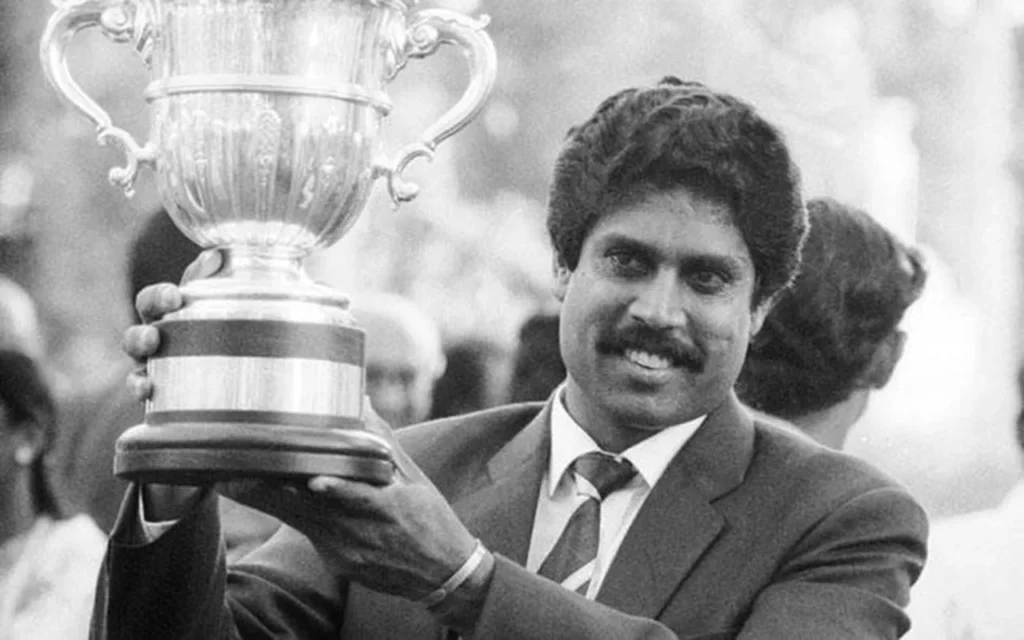
Lord’s Cricket Ground, London — 25 June 1983
How 1983 Changed Indian Cricket Forever,
Kapil Dev’s legendary squad,the journey to the final and how one victory created a billion cricket fans
By Sticky Wicket | Cricket History | June 25, 2025 | 7 min read
It was a Saturday afternoon in London. India — 66-to-1 outsiders, a team that had never won a single World Cup match against a top side — walked out to face the mighty West Indies in the final of the 1983 Prudential World Cup at Lord’s Cricket Ground. Nobody gave them a chance. History had other plans. What happened that day did not just win India a trophy. It rewired an entire nation’s relationship with cricket. It turned a sport into a religion. It created the BCCI — now the wealthiest cricket board in the world. And it produced a generation of young Indians who picked up a bat and dreamed of doing what Kapil Dev and his band of brothers had done.
We were not supposed to win. Nobody told us that. So we just went out and won."
— Kapil Dev, Captain, India 1983
The Underdogs Who Dared
India arrived at the 1983 World Cup without expectation. They had participated in the previous two editions — 1975 and 1979 — and won just one match across both tournaments. The West Indies, led by the imperious Clive Lloyd with a batting lineup of Viv Richards, Gordon Greenidge, Desmond Haynes and backed by a terrifying pace attack, were the defending champions. Twice over.But India had Kapil Dev. And on a grey afternoon at Tunbridge Wells, when India had collapsed to 17 for 5 against Zimbabwe — a minnow nation making their World Cup debut — Kapil Dev walked in and played the greatest innings in one-day cricket history.
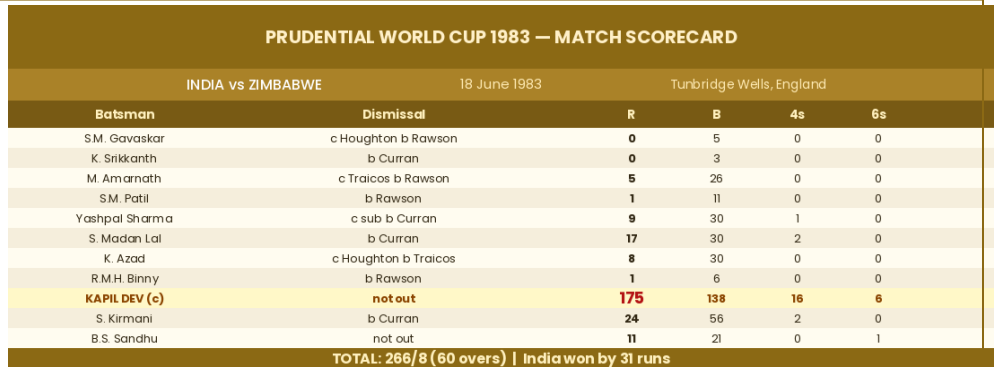
Scorecard: India vs Zimbabwe, Tunbridge Wells — Kapil Dev’s historic 175 not out
175* — The Innings That No One Saw
When Kapil Dev arrived at the crease on June 18th, India were in ruins. The top order had crumbled embarrassingly against Zimbabwe — a team playing their very first World Cup. What followed over the next 138 balls was nothing short of miraculous. Kapil Dev scored 175 not out, hitting 16 fours and 6 sixes, completely rebuilding India’s innings from 17 for 5 to 266 for 8.
Remarkably, not a single television recording of the innings exists. The BBC had gone on strike that day and turned off their cameras. One of cricket’s greatest innings lives only in memory, in the minds of the handful of spectators present, and in the words of those who played it. That absence makes it even more mythical —like folklore passed down through generations.
The Legendary Squad
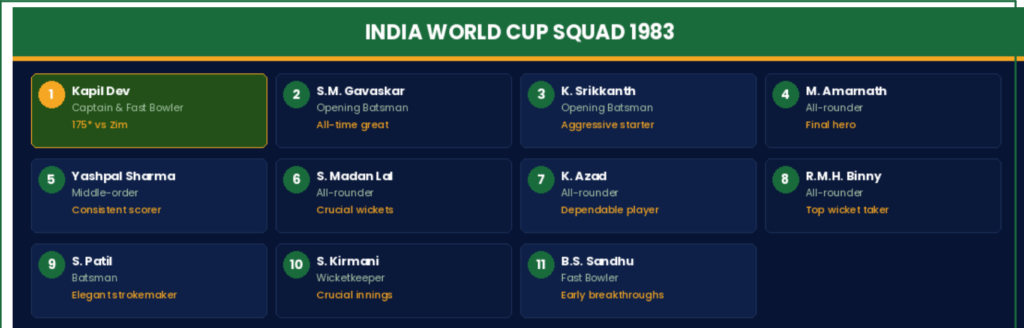
India’s 1983 World Cup squad — the men who changed cricket history
The squad was a beautiful mix of experience and hunger. Sunil Gavaskar brought calm authority at the top. Krishnamachari Srikkanth brought fearless aggression. Mohinder Amarnath, the tournament’s Player of the Match in the final, contributed crucial wickets at the right moments. Roger Binny finished as the tournament’s highest wicket taker with 18 scalps. And behind the stumps, Syed Kirmani held everything together with quiet brilliance.
The Final — June 25, 1983
India batted first and managed 183 all out — a total that seemed dangerously low against the most powerful batting lineup of the era. Richards alone had dismantled better attacks. But India bowled with extraordinary heart. Madan Lal removed Richards for 33, and suddenly the impossible felt possible. Wickets tumbled. The West Indies, chasing a target even a club side might have knocked off, collapsed to 140 all out. India had won by 43 runs. Kapil Dev lifted the trophy at Lord’s. An entire nation stopped breathing, then erupted. Streets across India filled with celebrations that lasted days. A country that had treated cricket as a pastime suddenly understood it as destiny.
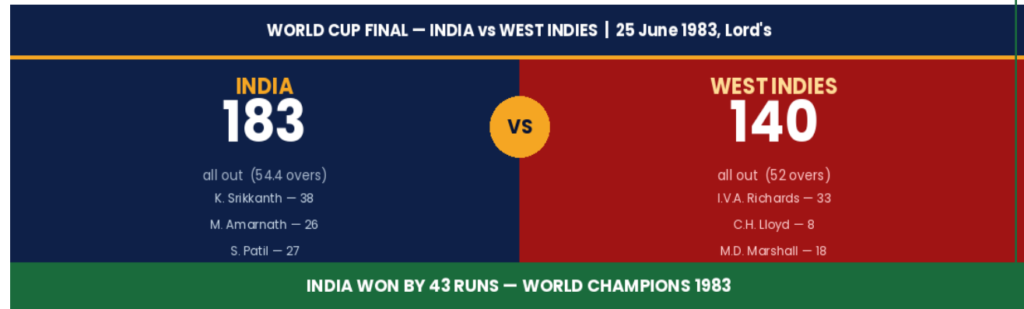
Final Scorecard: India 183 defeated West Indies 140 at Lord’s
The Legacy — A Billion Dreams Ignited
The ripple effects of 1983 are still being felt today. Sachin Tendulkar, who was nine years old when Kapil Dev lifted that trophy, has spoken often about how that win made him pick up a bat seriously for the first time. MS Dhoni, who finished India’s 2011 World Cup win with a towering six over long-on at the Wankhede, was inspired by exactly those same images from 1983. The line from Kapil’s World Cup to Dhoni’s is a direct one. The BCCI transformed from a modest administrative body into the world’s most powerful cricket organisation. Television rights, sponsorship, the IPL — all of it traces its roots back to that one June afternoon at Lord’s.
When India won in 1983, cricket became commercially irresistible in a country of hundreds of millions. The sport would never be the same.
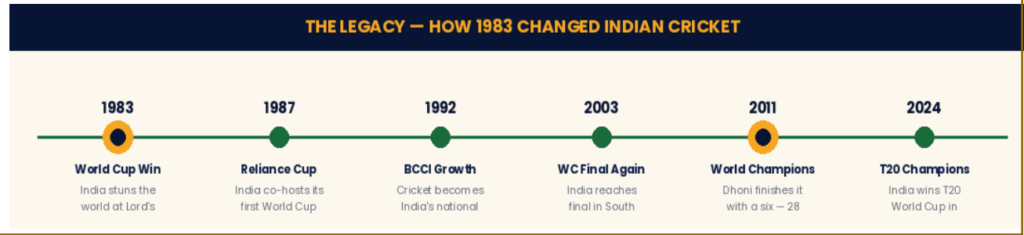
The cricket legacy that began at Lord’s in 1983 and continues to this day
"Before 1983, we played cricket. After 1983, we lived it."
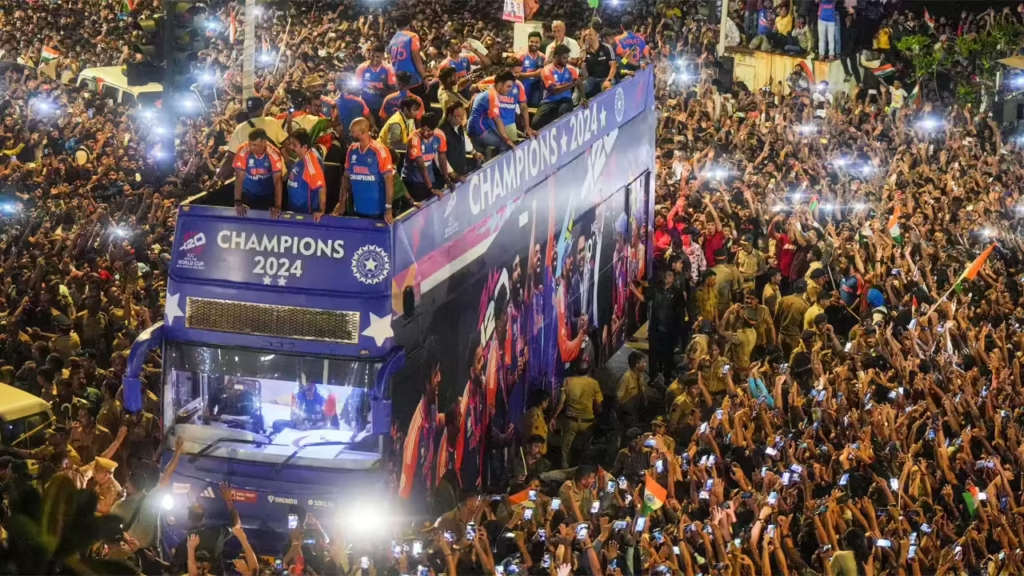
Forty-two years have passed since that Sunday afternoon at Lord’s. The players have aged, the trophies have multiplied, and Indian cricket has scaled heights that the 1983 squad could never have imagined. But the spirit — that fearless, against-all-odds belief that a group of outsiders could walk into the biggest stadium in the world and own it — that spirit was born on June 25, 1983. It has never left. Every time an Indian batsman hits a six in a World Cup. Every time a fast bowler roars at the sky after a wicket. Every time a billion people hold their breath as the last over approaches — they are all, in some small way, living inside the dream that Kapil Dev and his men made real at Lord’s.
